Option A
Multi-Use Recreation Facility
Plan for Growth. Use What We Have. Build What We Need.
Collingwood needs community facilities that support healthy living, culture and a vibrant downtown — without asking taxpayers to carry more risk than they should.
This paper covers two major discussions:
The concept graphics are shown first so you can see the options clearly before reading the detail.
Option A
Plan for Growth. Use What We Have. Build What We Need.
Option B
Support the Arts. Respect Downtown. Limit the Taxpayer’s Risk.
I support the Town’s purchase of land for the long-term consideration of a Multi-Use Recreation Facility (MURF) or other combined community facility. Securing land while it is available is good long-term planning. It protects options for future Councils as Collingwood grows.
But buying land does not decide what we should build, how large it should be, or when it should be built. Those decisions need current facts about recreation demand, existing facilities, partnerships, costs and the Town’s ability to pay.
Before Council commits to a building program, I want an updated community-wide needs assessment. It should look at ice, pools, gyms, fitness space, community rooms and other recreation needs. It should use current registration, actual facility use, population growth, regional users and operating costs.
The right question is not: “How much can we put into a new MURF?” It is: “What mix of existing facilities, partnerships and new construction best meets Collingwood’s needs at a sustainable cost?”
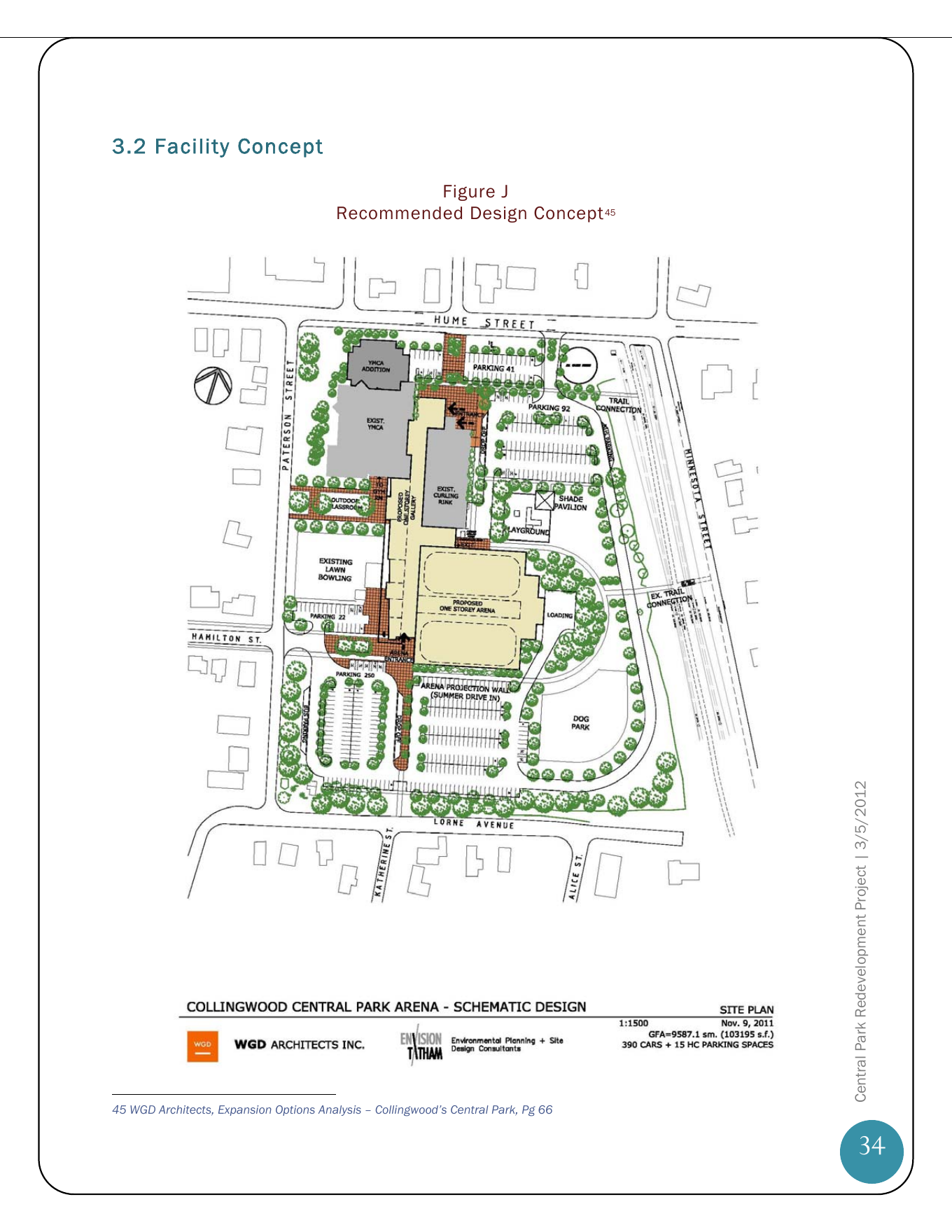
Collingwood does not need to start from scratch. In 2012, the Central Park Redevelopment Steering Committee studied Central Park as an integrated recreation centre. The work included public input, needs analysis, concept design, capital and operating estimates, and a possible partnership with the YMCA.
The recommended concept included twin NHL-sized ice pads, an expanded YMCA with a new six-lane 25-metre pool, the curling rink, lawn bowling, a walking and running track, community space, parking, park improvements and trail links.
The study also recorded a clear public concern: the project should not be funded only through taxes.
The Central Park plan did not simply disappear onto a shelf. The Town later built recreation infrastructure there with future expansion in mind. The outdoor ice pad was planned so it could be enclosed and twinned in the future, with shared ice-making infrastructure connected to the adjacent Curling Club.
The Town has since made another major investment by adding a permanent roof over the outdoor rink. In 2025, Council also directed staff to examine enclosing that rink as a way to add ice sooner while the larger MURF process continues.
Before building two entirely new ice pads elsewhere, we should fully test the future value of recreation infrastructure taxpayers have already paid for at Central Park.
Central Park may or may not be the final answer. The new land may prove to be the best long-term location for a large combined facility. My point is that we should compare the options before we leave useful public assets behind.
A new MURF would not enter an empty recreation market. Collingwood already has the Eddie Bush Memorial Arena, Central Park Arena, the covered outdoor rink, Centennial Aquatic Centre, the YMCA and private recreation and fitness facilities.
Before building new facilities, Council needs to understand what happens to the ones we already have.
There should be no predetermined closures. But taxpayers should not build a major new complex and only later discover that they must keep paying for duplicate facilities.
The YMCA should be part of this discussion as a potential not-for-profit partner. The 2012 Central Park work recommended a Town-YMCA partnership that could include operations, service delivery, fundraising and investment. I would reopen that conversation.
I would also explore opportunities with the Simcoe County District School Board. Schools and municipal recreation facilities serve many of the same families. They may also need similar gyms, fields, parking and community space. If land, facilities or costs can be shared, we should examine that before taxpayers fund duplication.
Other community, municipal and private-sector partnerships should also be considered.
We should plan for what Collingwood may need over the long term without assuming every part must be built on opening day. A master plan can protect space for future phases while we build what current demand supports.
Build what we need today. Design for tomorrow. Expand when population and use justify it.
The MURF is not Collingwood’s only major capital need. We face large water and wastewater projects, including the Wastewater Treatment Plant, along with roads, stormwater systems and other infrastructure needed for growth. A Performing Arts Centre is another possible major investment.
All of these projects draw on some mix of reserves, development charges, grants, borrowing capacity and taxpayer or ratepayer dollars. They must be looked at together, not one at a time.
A Long-Term Financial Strategy Plan should show:
Some critical infrastructure cannot simply wait because another project is more visible or exciting.
Infrastructure Before Crisis applies here too.
I support a Performing Arts Centre in downtown Collingwood. A successful centre can strengthen the arts, support tourism, bring people downtown year-round and create more activity for local restaurants, shops and businesses.
But support for an Arts Centre does not mean the Town must develop, own and operate it.
My preferred model is a privately developed, owned and operated Performing Arts Centre.
I see the Town as an enabling partner, not automatically the owner and operator. The municipality can provide meaningful support while limiting the long-term risk to taxpayers.
I would consider making suitable municipal land available through a long-term lease at a nominal cost. Subject to the law, a sound business case and Council approval, the Town could also consider deferring, reducing or waiving development charges, building permit fees and other municipal fees.
I would consider total municipal in-kind support of up to about $10 million in value.
That is real public support. But it is very different from having taxpayers finance a $60-million-plus municipal building and then carry its operating risk.
The balance should come from a mix of private investment, not-for-profit participation, community fundraising, sponsorships and Provincial and Federal funding. The proponents must show that the centre can be financed, built and operated in a sustainable way.
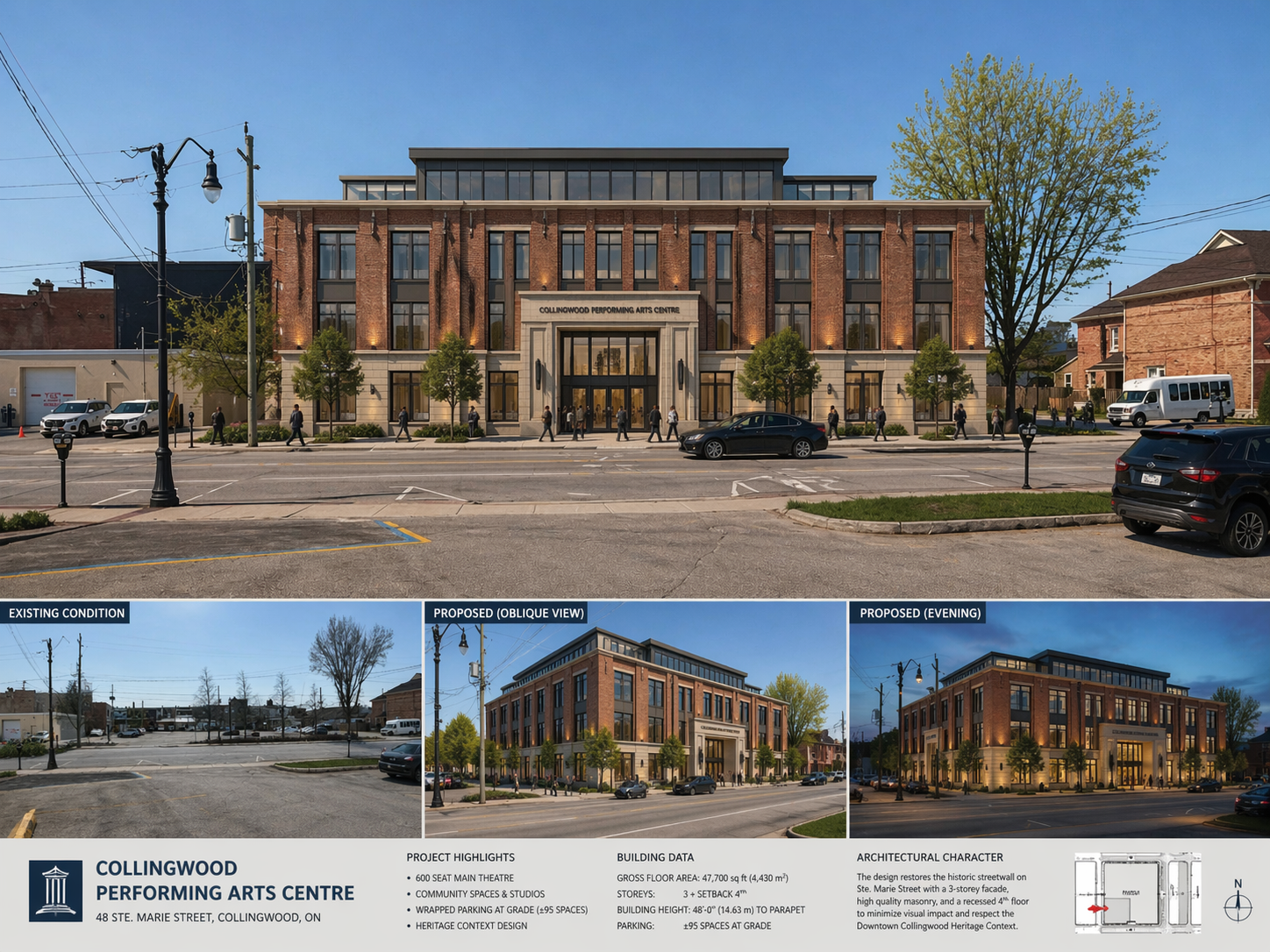
Our campaign’s 48 Ste. Marie Street concept is based completely on the publicly presented CACE plan and report for this site. My team did not change the basic Performing Arts Centre program or try to replace CACE’s planning work.
We used the CACE concept as the starting point and looked at only two issues:
Those are the only two issues my team set out to address.
The campaign concept is independent. It has not been prepared, reviewed, approved or endorsed by CACE. CACE does not endorse this concept.
48 Ste. Marie Street is now a municipal parking lot. A major public attraction will create parking demand of its own. If it is built on an existing parking lot, we also have to deal with the spaces that are displaced.
Our concept asks whether some existing grade-level public parking can remain as part of the project. That is a modest claim. The concept still needs detailed traffic, parking, structural, planning and cost work.
If we use municipal parking land for a Performing Arts Centre, parking must be part of the plan from the beginning.
A Performing Arts Centre could be one of the most important new buildings in downtown Collingwood in generations. If it is built in the Downtown Heritage Conservation District, I believe it should respect that setting.
I do not believe the modern architectural treatment shown to date is the right fit. Our team kept the CACE program and explored a different outside expression — one that responds more closely to the scale, rhythm and character of traditional downtown Collingwood.
This does not dictate the final architecture. That work belongs with professional architects, heritage experts, planners, engineers, the public and the Town’s approval process.
A modern Performing Arts Centre and heritage-compatible architecture are not opposites.
The Downtown Heritage District Design Guidelines should shape the design from the start, not be checked after the building is already designed.
Architecture and parking matter. But the larger question is the business model.
Before taxpayers make a major contribution, five questions need clear answers:
Under my preferred model, those answers should not all be: “The Town of Collingwood.”
The Town can help through land and suitable in-kind support. Private and not-for-profit partners can bring investment, fundraising, operating skill and financial responsibility. That option should be tested before taxpayers are asked to take on the full capital cost and long-term operating risk.
Even in-kind municipal support has a real value. The Arts Centre must be included in the same Long-Term Financial Strategy Plan as the MURF, Wastewater Treatment Plant and Collingwood’s other major infrastructure needs.
Residents should be able to see the full financial picture before Council makes these decisions.